Life has been a cycle of constant motion for the last few months. Multiple visits to MD Anderson balanced with work deadlines have left me feeling several shades of tired. To compound everything, Chris was sick with a cold last week. This week, I'm sick with his cold. I'll cover how it's being dealt with a little further down.
First things first, I saw my endocrinologist last week. He noted that I am displaying cushingoid features more prominently than when he last saw me. My face is taking on that distinctive moon pie shape long-term steroid users tend to get. I have a hump of fat across my neck and shoulders. You read that correctly. A hump. My doctor verified its existence. It does happen when you've been on high-dose steroids long enough and particularly when you're steroid-sensitive. My legs are the skinniest they've ever been. Unfortunately, steroids help the body to redistribute weight. For me, I get all of it solidly around my middle. All the way around. It's like having a fatty tire permanently fixed around your midsection.
All things considered, Dr. J. gave me an A+. My thyroid levels are being controlled by daily medication. I'm still managing to take the stairs at work, thereby fighting against steroid weakness and muscle atrophy in my lower body. I'll see Dr. J. again in a few weeks just to be sure things continue going well. I'll also have another bone density scan to see what damage being on steroids for so long has done to my bones.
This week, I saw my transplant doctor. While there, I had Chris on speaker phone so he could participate in the visit. He confessed to being sick in order to alert the team to the possibility that I'd been exposed. To his credit, when he realized that he was coming down with something, he called his doctor, who in turn prescribed something to help Chris along.
My breathing remains difficult. I feel like I'm improving, but I'm nowhere near the point in recovery that I was experiencing before weaning off of steroids all together in December. During the visit, it was noted that my lungs continue to sound clear. Since things aren't getting worse and I feel like I'm moving forward, the decision was made to step the steroids down again. I'm now taking 20 mg of prednisone every other day. In two weeks, I'll step down to 15 mg every other day. The team is giving me a little break and allowing me to return in a month rather than maintain the 2 week schedule I've been on. I couldn't be happier. The drive was becoming a grind.
As for the cold, I realized that the little monster had taken hold yesterday. My head was congested and my nose was constantly running. My transplant team advised me to get in touch just in case Chris had passed along his cooties, and I definitely reached out. I'm on a 7 day course of Avantin in addition to all of the other antibiotics I already take as prophylaxis while on steroids and tacrolimus. There's nothing more that I would love to do than curl up on the couch and sleep for three days. Unfortunately, the steroids keep me in a perpetual state of wakefulness, so no naps here. I'll settle for a long weekend of cheesy movies wrapped up on the couch while the cats take turns demanding treats and attention.
Friday, February 14, 2014


Wednesday, January 29, 2014
Another 2 weeks
I saw my transplant doctor at MDA on Monday and all went as expected. My lungs sounded clear. I'm still on steroids and dealing with the side effects. Dr. K. wants to slow the steroid taper down to give the drug a better chance of shutting down the GvHD in my lungs. So now I'm taking 30 mg of prednisone every other day and will return to Houston in 2 weeks for another checkup.
Next week is my standing appointment with Dr. J., my endocrinologist. I don't think there will be any surprises.
Next week is my standing appointment with Dr. J., my endocrinologist. I don't think there will be any surprises.
Sunday, January 19, 2014
Learning to live with an unwanted guest
GvHD is something that I've resigned myself to living with. It affects one system or another, or multiple systems when it's feeling really frisky, on any given day. It's the thing that keeps leukemia at bay. It's also a thing that can kill me if left unchecked.
Since July of 2013, I've been on steroids for GvHD of the lungs. I started at 60 mg of prednisone per day and slowly tapered to nothing as of December 13, 2013. Things seemed good. I was taking the stairs at work, per my doctor's orders and working on building up lung volume. The most recent pulmonary function test prior to stopping steroids showed my lung volume up from 55% to 67%. That's not too shabby. Of course, that didn't mean I wasn't running out of breath at the top of the stairs or contemplating taking up running any time soon. It meant I wasn't struggling to breathe on a regular basis. Humid days still gave me trouble, but not the gasping, fish out of water feeling that sometimes overtook me on a really bad day.
I began feeling short of breath again on December 26, 2013. Nothing terrifying, just a slight inability to catch my breath doing the most mundane thing. Having been down this road twice before--and having learned my lesson after contracting pneumonia from being stubborn and stupid, I recognized this for what it was. The GvHD in my lungs hadn't resolved.
It takes 14 days for steroids to leave your body. Prior to this episode I'd been on a two week taper interval. I'd been taking 5 mg of prednisone per day for 14 days before I finally stopped. December 26 marked 13 days from my last dose. Close enough.
My transplant doctor saw me on 12/30. She looked me over and listened to my lungs. Much to her surprise, my lungs sounded perfect. What can I say? I'm her outlier. She started me on 30 mg of prednisone and had me come back 2 weeks later. I saw the pulmonary specialist, my transplant doctor, had a CT scan, pulmonary function test (PFT), and a 6 minute walk test.
I confounded both doctors once again. The results of my 6 minute walk test fell firmly in the middle range of normal for a healthy person. My oxygen saturation never fell below 98%. My CT scan showed some slight improvement in the areas of ground-glass opacity (pneumonia) over the CT scan results from 12/4/13. My lungs sound clear. My lung volume has fallen from 67% to 57% in less than a month. The pulmonary specialist can't explain it. She wants me to repeat a PFT in 6 to 8 weeks. She also asked me to pursue more vigorous exercise in addition to the breathing treatments and steroids and stair taking. She told me of all her patients, I'm the one most vigorously pushing to get better. You better believe it.
So now I'm walking on the treadmill at a 10% incline for at least 20 minutes a day. I try to do more, but some days don't have enough hours. I'm also having problems with severe foot cramping, which does interfere with walking on occasion. Steroids. Can't do a thing about it.
There are some other steroid related issues that you'll be familiar with from past blog posts. Severe mood swings. Insomnia. Constant shaking. Weight gain. Let's just say I'm super fun to be around on any given day.
The good news is that my team wants a quick taper. The bad news is that they're worried about permanent adrenal atrophy due to steroids. Yay. I'm currently alternating 30 mg of prednisone with 15 mg every other day. We'll see what the doctors want to do when I see them next at the end of the month.
I'm also scheduled to see my endocrinologist in February. He's got a fabulous sense of humor, so I can't wait to see what his take is on all of this.
I continue to stay busy at work and the cats and Chris are on top of things, so no worries there. My hair is slowly starting to fill in. More salt than pepper these days. You can still see my scalp, but it's not quite as obvious and people don't stare as much. I do realize that it will fall out again at the end of this and that's okay with me, so long as I'm still breathing.
Sunday, December 8, 2013
The Good, the bad, and the balding
I'm going to be honest, I've been avoiding blogging for the last few months for a number of reasons.
To begin with, I've been working the kind of hours that would make you, gentle reader, fuss at me with ferocity. It is a very busy time of year in my industry and my work ethic refuses to allow me to leave coworkers in the lurch. I'm not being forced to work the hours that I'm working by my bosses. I'm working the extra hours from the comfort of my home, through a virtual desktop which is much nicer than being chained to a desk, lest you get the wrong idea, and doing it of my own volition. There are deadlines to be met and I don't want to be the one holding things up.
Since my steroid taper has hit a certain level, I have been experiencing a constant state of fatigue. Not cancer fatigue, or chemo fatigue. The kind of fatigue I'm living through is related to the fact that my adrenal glands went dormant shortly after I went on high-dose steroids in July. The steroids were synthetically producing the hormones that the adrenal glands would have been, and so those sweet glands went into hibernation. Then they got lazy and stopped doing anything altogether. Once I tapered down to about 15 mg of prednisone per day, I noticed that my hair was thinning and that I was beginning to put on weight.
The last time I was on high-dose steroids for GvHD of the liver and lungs, my face went cushingoid (think moon pie) and my weight sky-rocketed 64 pounds in a very short period of time. This time, no puffy face and my weight remained stable until the prednisone slowly tapered from 60 mg per day to 15mg daily. It's like a switch went off. By the time my taper reached 10 mg per day, I managed to gain 17 pounds and most of my hair fell out. This is because the steroids aren't producing enough hormones to sustain what my body needs and my adrenal glands are still dormant. I look like I'm going through chemo again. In fact, several people have approached me with worry over whether the chemo is working. I still haven't figured out how to distill the answer as to why I appear as I do into a single sentence. I'm not going through chemo. My adrenal glands are being giant turds.
Now let me work my way back from my most recent visit to MDA.
Last week, I had a CT scan of my chest to get a better understanding of why the GvHD in my lungs hasn't resolved to a degree that makes the pulmonary specialist and my transplant doctor happy. I also had another pulmonary function test (PFT). The last 3 PFTs showed my lung capacity at 55%. That's not good. It should have been improving, even if only by a very little each time. No dice. When I saw my transplant doctor the week before this, she remarked that we'd be doing a lung biopsy if there wasn't significant improvement. Her thinking was that there may have been something other than GvHD of the lungs involved. Imagine my delight at the thought of getting to live through another lung biopsy. They are not fun and you cough your way through the entire event, even though you're under anesthesia. You cough so much, that you often wake yourself up during the event, which is why the anesthesiologist is on standby with more sleepy-time juice.
I got to see my most recent CT scan next to the one taken in July, while I was in the hospital with lung GvHD and pneumonia. There is improvement. You can still see areas of what are known as ground-glass opacity in my lungs. This refers to areas where pneumonia is still present. It's not as bad as it was, but there's still pneumonia in both lungs. There are also still infiltrates, and I am not surprised given my inability to breathe.
Before I go any further, I should mention that my transplant doctor instructed me to start taking the stairs up to my second floor office at work. Now that Chris and I work for the same company, he makes sure that I'm doing it. I'm out of breath by the time I reach the second floor landing, but I don't need my rescue inhaler anymore. I should also probably admit to bumping up my breathing treatments to twice a day.
When I was first given the nebulizer, I was instructed to have treatments twice a day. I did while I was at home recuperating. Once I went back to work, it became impossible and I was given permission to cut back to once a day. After my third PFT came back unchanged, I rearranged my daily schedule so that I could bump back up to 2 a day. Don't ask me how, but every day is a pain in the butt as a result of it.
No complaints, and here's why: my latest PFT showed that my lung capacity is up to 67%. This is nowhere near normal. A healthy person's capacity falls somewhere between 85-100%. I will never ever reach 85% again in my lifetime. Too much scar tissue in my lungs. I'm aiming for as high as I can get.
I'm hoping that once my transplant doctor gets the results, the lung biopsy falls off the table. As for my pulmonary team, they told me to keep doing what I'm doing and they'll see me in 3 months. Big smiley face there.
Here's the bit that I haven't really wanted to write about. 3 days before my birthday in October, Chris and I met with the reproductive endocrinologist recently hired by MDA. She specializes in cancer patients and their fertility. I have had my fertility tested twice before. After my first transplant, I was still able to produce eggs. After my second transplant, the tests proved inconclusive. It has been the very worst emotional roller coaster you could possibly imagine. Having had cancer 4 times, not to mention 3 different varieties of cancer, was nothing compared to this emotionally.
I'd had a special blood test done the month before. It takes about 3 weeks to process and has to be sent off for interpretation. I cheated before the meeting and looked up the results. The protein they were looking for was immeasurable in my sample. I knew what this meant. The day of the meeting, I also had another transvaginal ultrasound. It took close to 20 minutes for the technician to locate my right ovary. Can you see where all this is headed?
Upon meeting with the very kind doctor, I was told that there was not a single egg follicle left in either ovary. I cannot have children naturally. She did reassure me that I could carry a pregnancy using a donor egg fertilized by Chris. First, I have to kick the lung GvHD to the curb and get off of all of the drugs working to suppress my out of control immune system. This won't happen overnight. At best, maybe sometime late next year we can begin investigating options. Also, Louisiana doesn't have a donor egg program, so I would have to go to Houston to have it done. I've been advised to shop around for fertility clinics since prices and practices vary widely. We've also looked into private and public adoption. The cost of IVF using a donor egg runs roughly the same as private adoption. And trust me when I say donor eggs are not free.
We have time to make the decisions that need to be made. In the meantime, I'm very happy with the reproductive endocrinologist and the game plan she will have in place once I make a decision.
So there you have it. Chris still owes you patient readers part 2 of our meeting with sweet Dana, my donor, and Hung, her husband. He's been busy getting acclimated to his new job, so you may need to prompt him through the comments section.
I'm tired, because of my slowly waking adrenal glands, and consumed with doing everything I can to stay awake during the day. I know there will come a point sometime next year when this is behind me and I get to move on to the next portion of my life when I will forget the harder days and look forward to posting more about the things I now welcome as normal.
Monday, November 18, 2013
Sorry for the delay
Sorry for the delay everyone. I promise Part 2 is on the way. I have recently started a new job and lots of things are in flux at the moment.
Sunday, October 20, 2013
Rafu write-up
Here's a link to a write-up the A3M event we were so lucky to be a part of.
In case you don't want to click through, a copy of the actual piece runs below.
http://www.rafu.com/2013/10/
THE GIFT OF LIFE
A3M introduces marrow transplant recipients at annual gala.

Ann Gregory (right), accompanied by her husband, Chris, was introduced to her bone marrow donor, Dana Lau, and her husband, Hung.
By J.K. YAMAMOTO, Rafu Staff Writer
When someone says, “You’re a lifesaver,” it’s usually a figure of speech. But when special guests said it at Asians for Miracle Marrow Matches’ (A3M) annual fundraising gala on Saturday at the Hyatt Regency Downtown Los Angeles, they really meant it.

Emcee Denise Dador from ABC7 Eyewitness News.
A3M is dedicated to finding bone marrow donors for Asian American patients with leukemia and other life-threatening blood diseases. A tissue match between donor and patient is needed for a successful transplant, and the best chance of finding a match is among family members or people of the same ethnic/racial background.
“There’s a lot of things that have changed since the inception of A3M 22 years ago … Back in 1991 there were literally no Asians in the marrow registry,” said A3M Director Shin Ito. “If you were of Asian descent and you had leukemia and you needed a marrow transplant, you pretty much had no chance.
“Now flash-forward to 2013. There are over 750,000 donors of Asian Pacific Islander descent in the marrow registry. That’s wonderful … but at the same time there are still far too many patients that unfortunately just don’t make it, so that’s why we still need to do what we’re doing …
“Every year, 12,000 patients need a marrow transplant … 70 percent of them need to search the marrow registry because they don’t have a sibling match. A3M is able to do 600 drives a year … Over 15,000 donors register at A3m drives every year. Last year 59 donors who registered at A3M drives donated their marrow or blood stem cells to give patients a second chance … When I first joined A3M six years ago, there were only 25 people who registered at A3M drives and donated their marrow or blood stem cells.”
A3M has a tradition of introducing patients to their donors during its annual gala, and this year was no exception.
The patient was Ann Gregory, who is of English/Irish descent on her father’s side and Vietnamese/Chinese on her mother’s side. She was diagnosed in 2007 with acute lymphoblastic leukemia (ALL). In the absence of a suitable marrow donor, she had an umbilical cord blood transplant after a legal and media battle with her insurance company, which initially called the procedure experimental and refused to cover it.
“I managed to stay in recovery for 13 months before a relapse … It bought me enough time for a donor to be found, and I’m just so grateful,” said Gregory, who was accompanied by her husband, Chris.
The donor was Dana Lau, who registered 16 years ago during a marrow drive for 3-year-old Alana Dung in Hawaii. Lau was not a match for Alana, who later passed away, but 10 years later had another chance to save a life when she was identified as a near-match for Gregory.
“We weren’t a perfect match on the human leukocyte antigen (HLA) front, but she was perfect enough to save my life,” Gregory said. “I just want her to know that she helped facilitate a miracle and I’ll be forever grateful for her selflessness.”
“The Hawaii Bone Marrow Registry team was so helpful and supportive in trying to accommodate my busy life of being a teacher, wife and mother … I remember the love and sometimes protective support of my family and close friends,” said Lau, who was accompanied by her husband, Hung.
Although donors have the option to decline, Lau said, “Ultimately, one thought guided me: How could I not help to save someone else’s life?”
The two couples embraced on stage. Gregory told Lau, “You made this possible. Five years later I’m standing here because of you. I have a lot more years with my best friend, the love of my life.”
Lau said she was thankful for the opportunity and asked Gregory and her husband to “live your days and your lives to the fullest.”
Noting that mixed ancestry makes it harder to find a donor, Gregory told the audience, “That’s why it’s so important for organizations like A3M and all the other ones out there (to be) running drives and registering people of mixed heritage, and I’m just so grateful that they exist.”
Emcee Denise Dador, health specialist for ABC7 Eyewitness News, said, “I’ve met patients before they’ve had their transplants, before they found their match. The sadness, the desperation that you feel when you talk to them … I know how difficult and critical it is to find a match for many.”
She also noted that in one case, a donor’s husband refused to let her go through with the procedure because he feared, incorrectly, that it would affect her ability to have children. Dador stressed the importance of clearing up misconceptions about marrow transplants.
Dador has been honored by the National Marrow Donor Program for helping to promote A3M’s mission.

From left: Bone marrow recipients William Ko, Jenny Hirata, Celine DeGuzman, Seung Hong, David Bao, Kaili Nguyen and Nancy Sakakura.
Seven Stories
Another success story is Nancy Sakakura, a wife and mother who was diagnosed with myelodysplastic syndrome (MDS) in 2002. Already registered as a donor with A3M, she instead became the focus patient of a massive donor recruitment campaign. While her condition deteriorated, two people were identified as matching donors, but both turned out to be unavailable. Finally, a 23-year-old from Japan donated marrow that was successfully transplanted in 2006
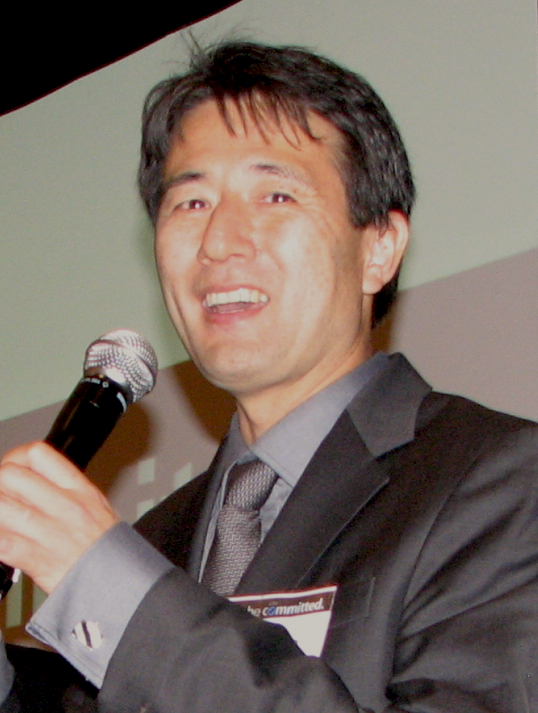
Dr. Ryotaro Nakamura of CIty of Hope has worked with A3M patients.
“Being sick with a serious illness is something that most people don’t think about,” Sakakura remarked. “When it happens, it’s surreal. There are emotional hurdles as well as financial and logistical challenges. Many families go through extreme financial hardship trying to save a family member, some declare bankruptcy, some divorce, some relocate with no new jobs lined up in order to seek treatment, some people simply give up …
“A3M was really there for me during my journey … A3M helped channel the array of emotions into positive energy keeping us focused on finding that one special donor.”
Sakakura introduced other patients who owe their lives to A3M:
• William Ko was diagnosed with chronic myelogenous leukemia (CML) at age 33. Roselle Espiritu was found to be a match and the transplant was done in 1994. Ko, who also survived a mild heart attack last year, has sons who are 20 and 23 years old.
• Jenny Hirata was diagnosed with acute myelogenous leukemia (AML) at age 9. After chemotherapy and blood and platelet transfusions, the cancer returned. Cynthia Yamaguchi, who registered at a Krafty Delights craft fair, was found to be a match and the transplant took place in 1993. Hirata now performs with a taiko group and is pursuing a master’s degree in speech therapy at CSU Northridge.
“When I was in the hospital or even when I was at school and having kids stare at me, my one wish was to have a normal life,” she said. “I can say that I’m living that right now and I have been for a while. I have my donor Cynthia to thank for that and I also have A3M to thank … Having all of these booths at different events really does save lives.”
• Seung Hong was diagnosed with CML in 1999. A donor was found through A3M, but the man had a medical condition that did not allow him to undergo the procedure. After his condition progressed to AML, another match was found and the transplant was done in 2000. As a result, he was able to celebrate his 60thbirthday, walk down the aisle with his daughter, and spend time with his four grandchildren.
• Celine DeGuzman was found to be suffering from aplastic anemia when she was only 8 months old. Luckily, she found a donor in Hawaii in less than six months. Thirteen years later, she is attending junior high school and wants to become a nurse. She met her donor for the first time at an A3M event.
• Christine Pechera was given only a month to live when she was diagnosed with cancer. After enduring high-dose chemotherapy, full-body radiation and a bone marrow transplant, she suffered a relapse and had to find another donor. Eleven years after her diagnosis, she is happily married and graduating from Pepperdine University with a master’s degree. She also was introduced to her donor at an A3M event. Due to an auto accident, she was unable to attend this year’s gala.
• David Bao, a husband and father, was diagnosed with ALL in 2009 and underwent chemotherapy. He found a match through the Tzu Chi Registry and had his transplant that same year. Last month, he was able to meet his donor in Taiwan.
“The trip out there took 31 hours … I had an opportunity to talk to my donor for about 20 minutes … It was truly worth it. She’s an angel,” he said.
• Kaili Nguyen was diagnosed with MDS at age 3. After several cycles of chemotherapy, she found a match through A3M. She suffered a relapse a few months after the transplant, and the doctor gave her more of the donor’s stem cells. Three years later, she is a second-grader who wants to be a pediatrician. She and her donor recently took a trip to San Francisco.
Sakakura also introduced “gifted, amazing, committed doctors” from City of Hope who have treated A3M patients: Auayporn Nademanee, Ryotaro Nakamura, Pablo Parker and Chatchada Karanes.
“I really respect and honor those people who … donate what they have,” Nakamura said. “Without those cells from all these donors, we are no use, actually … You are the ones that keep us moving forward.”

From left: Gene Kanamori, event co-chair; representing the Dale M. Inouye Foundation, Shannon Kitani (for Harvey Kitani), Randy Kiehm, Scott Mibu and Cathie Tani; A3M Director Shin Ito.
Remembering Dale
The Human Spirit Award was presented to the founders of the Dale M. Inouye (DMI) Foundation: Randy Kiehm, Harvey Kitani (represented by his wife, Shannon), Scott Mibu and Cathie Tani. Established in memory of Dale Inouye, who died of leukemia in 2008 at the age of 9, the foundation raises funds for cancer care and cancer research through a youth basketball tournament and a golf tournament, and collaborates with A3M in conducting donor registration drives.

Krissy Kobata is both an A3M volunteer and a patient.
Kiehm, an educator and coach with the L.A. Unified School District, said, “Dale lived his life with uncommon courage, determination, inner strength and fighting spirit … He went to school, played basketball, baseball, golf, he performed hula, he was a Boy Scout … he liked visiting Hawaii. And he did all these things with an uncommon zest and enthusiasm, passion and appreciation
“I for one truly believe that Dale’s life and his passing were meant to inspire others. Julianne Inouye, Dale’s mom, would tell a story that got me thinking and led me to believe this. She would say at some point in Dale’s life he became aware of his fate and he had this conversation with his mom. He asked his mom to not forget him, and he asked his mom to not let others forget him.
“I thought, what if … he was thinking how his life could inspire others to better appreciate life or to be more courageous in their life, how his life could inspire others to join the fight against cancer? … He inspired me to do these things. If you think it’s a far-fetched idea because he was just a kid … I simply say that Dale was probably in a place that none of us have ever been before, and maybe in that place he had a clarity that none of us has ever had.”
Tani, an LAUSD educator and longtime friend and UCLA classmate of Dale’s mother, said that during the basketball tournament, held at Cal State Dominguez Hills in August for boys and girls in grades 4 through 8, one player from each grade level receives the Dale Inouye Inner Strength Award. “That player is nominated by his coaches and selected by a committee for a player who demonstrates the kind of life qualities that Dale shared with us, his perseverance, his gratitude to life and his love for his family and friends.”
Krissy Kobata, who is both an A3M volunteer and a patient, closed the program by saying, “There are still patients like me who are looking. My search has been six years … I’m very fortunate that I don’t look sick, I don’t feel sick. My situation is relatively stable for the most part, although you never know what could happen. But of all the people I met throughout the process that I have been diagnosed, all the patients, I’m actually the last one … due to the fact that they couldn’t find donors. It’s a very scary thing.”
She said of A3M, “These people who work day in and day out to try to find people donors — they mean something, and your support means something … Keep spreading the word to friends.”
Other speakers included Gene Kanamori, who co-chaired the event with his wife, Vickie. Entertainment was provided by singer Keiko Kawashima and pianist Scott Nagatani from the Grateful Crane Ensemble. The program also included a silent auction, a marrow donor drive, and a raffle drawing with two round-trip, first-class tickets from American Airlines (represented by Nancy Matsui) as the grand prize.
Photos by J.K. YAMAMOTO/Rafu Shimpo
Sunday, October 13, 2013
Reunification - Part 1
Last week, Ann and I travelled to Los Angeles at the invitation of Asians for Miracle Marrow Matches (A3M) to meet Ann's donor at a gala event.
In the last post I said that this feels more like an ending of sorts. But, apart from that rather vague description exactly where does one start in describing, let alone summing up the finale to what has been the most life changing episode in our lives?
To avoid breaking with tradition, I'll start with last Friday. We boarded a flight from Baton Rouge to Houston and then to LA. Both of us nervous and a little giddy at what was coming up. We had known about the A3M event for several weeks and had avoided saying anything about it on the blog, because anything can happen.
Exhibit one to this is Ann's latest bout with GVHD and pneumonia which landed her in the hospital. Right after that was the "5 Year" visit, the one where you're supposed to get the "golden handshake"; the one where the doctor says, "you look great" and "thanks for coming in", or most importantly "you survived / beat the odds / are cured" or some combination of words that equates to those sentiments. Ergo, posting that we were poised to take a "victory lap" with so many plates spinning seemed like tempting fate.

So last Friday, we boarded a flight from Baton Rouge to Los Angeles by way of Houston. The trip was anticlimactic to say the least. Modern air travel is only palatable because of the mass adoption of the smart phone and audio and video compression algorithms. 5 fours later and 2 hours ahead of what time we were used to, we arrived at LAX.

We were collected at baggage claim by Ahn Nguyen and her husband Ted (from A3M). As it turns out they were there not just to meet us but also to prevent us from accidentally bumping into Ann's donor and family who were flying the same airline from a different destintion and only about 10 minutes behind us. We were clueless as to the subterfuge, and just ready get our bags, and go. Ann was suffering the effects of jet-lag at this point much worse than I was. So after a great dinner and a brief tour of the city, we checked into out hotel room and almost collapsed.
The next day, the big event was scheduled for the evening, which left us most of the day to mess around. We did a little walking around downtown LA before Ann started worrying about her breathing. That sent us back to the hotel, but not before seeing most of downtown LA barricaded off by private security and teamsters who were there apparently to shoot a Kia Soul commercial. The film crews, cameras and Mercedes fitted out with steady cams were neat to look at - the day glow safety orange Kia...no so much.
Once back at the hotel we started getting ready for the big night.

Remember what it felt like to go out on a first date? Or junior Prom? Yeah - that picture just about sums it up. Nervous was the secret word of the day. Ann and I had joked several times about what would happen if we met her donor and she didn't like us. All joking aside, meeting Ann's donor wasn't just a very real possibility. In a matter of about three hours, it was a certainty. Don't think the thought of breaking my leg and having to go to the hospital didn't occur to me - it did.
Before we could flee, and spare the world from what unwholesome despicable people we were, Anh turned up at our room and ushered us down to the silent auction A3M was holding.

We arrived and ran into Nancy Sakakura! Long time readers of the blog will recognize Nancy as one of the people who comments most frequently and our history and friendship goes all the way back to the darkest days of 2007. Nancy was the 1st patient I ever reached to out who responded. She gave Ann and me such hope that the odds could be beaten, bone marrow transplants could be survived and life could begin to "look" normal once again. Nancy and her blog about her transplant at City of Hope gave us a road map of what treatment, transplant, engraftment and recovery would look like. I will be forever grateful to her for taking the time to share with us, because without her friendship everything would have been so much darker.

OK, so this is a good place to draw Part 1 to a close. Next update we have the event and meeting two of the most genuine and precious people in the world.
Subscribe to:
Posts (Atom)